Teaching & Speaking
Graduate teaching, engineering instruction, curriculum development, and invited presentations in applied AI.
I teach machine learning as an engineering discipline. I begin with the mathematical foundations, then carry models through data design, evaluation, deployment, and communication with the people who will use them.
CS3 Research Experience for Teachers
Main engineering instructor
For three annual cohorts of the NSF Center for Smart Streetscapes Research Experience for Teachers (RET), I have designed and led the core engineering curriculum for K-12 STEM educators. The four-week program turns current work in computer vision, urban data, and generative AI into material that teachers can adapt for their own classrooms. In 2026, the program introduced the CS3 AI Teaching Kit, and teachers worked with me to build their own kits that pair browser-based lessons with an offline NVIDIA Jetson Orin Nano Super kit.
ML foundations
Neural networks, circuits, loss and backpropagation, the arithmetic of training, validation, and model evaluation.
Computer vision
Convolutional networks, object detection and segmentation, tracking, depth estimation, annotation, and dataset design.
Language and generative models
Tokens and Markov chains, recurrent networks and transformers, attention, embeddings, diffusion, and responsible classroom use.
Deployable and agentic AI
YOLO training, edge deployment on Jetson and Raspberry Pi, agents and tool use, and publishing web applications.
CS3 AI Teaching Kit
The kit introduced in 2026 has two parts that teach the same ideas: browser lessons that run on any computer, and an offline kit that carries them to cameras and sensors on an NVIDIA Jetson Orin Nano Super. Coding agents help teachers read each program, change it, and build their own extensions.
Online: AI Training Toolkit
A browser application that needs no installation. Four sets of guided lessons lead from fitting weights by hand, through decision boundaries, hidden layers, optimizers, and generalization in the Model Playground, to tokens, Markov chains, recurrent networks, masked attention, and a small GPT trained in the browser in the Text Lab.
Offline: Jetson teaching kit
Thirteen camera lessons, from OpenCV basics and color recognition to face tracking, QR codes, and car recognition; twenty-five sensor lessons, from LEDs and buttons to ultrasonic ranging, NFC, and an accelerometer; and advanced programs such as a smart doorbell, a pose game, vision-based parking, and a TensorRT benchmark. Each lesson ships with an HTML deck, a printable PDF, notes, and the programs it teaches.
Intro to AI lecture series
Self-contained HTML decks written for the 2026 cohort. Each one opens in any browser and carries its figures inside itself.
Companion material: the visual slide set for publishing a static website from GitHub, sample agent instruction files (GUIDELINES.md and REVIEW_AGENTS.md), and the Daylighting Explorer and analysis used in the daylighting lecture.
Lecture notes and handouts
Notes, handouts, and tutorials from the 2024 and 2025 cohorts, which continued in the 2026 curriculum.
Classroom outcomes
Participating teachers developed complete lesson plans that connect AI engineering to science, mathematics, civics, and career education.
2025 lesson plans
2024 lesson plans
Columbia courses
Advanced Deep Learning
An advanced course on modern visual recognition, centered on implementation. Students moved from evaluation and segmentation through two-stage and one-stage detection, tracking, transformers, vision-language models, diffusion, and open-vocabulary systems.
Sequence: Metrics and segmentation R-CNN, FPN, Mask R-CNN, PointRend SSD and YOLO graph embeddings SORT, ByteTrack, BoT-SORT, DeepSORT ViT, DETR, Swin, Segmenter CLIP diffusion and ControlNet OWL-ViT Segment Anything Generative Agents
Neural Networks & Deep Learning
An introduction to deep learning from theory to practice, covering mathematical foundations, implementation, model design, and the empirical habits needed to train and evaluate neural networks well.
Sequence: Machine learning review feedforward networks and backpropagation optimization convolutional networks regularization recurrent networks autoencoders GANs VAEs current research directions
I also co-taught Columbia Video Network’s VOAI 0003E: Neural Networks and Deep Learning for the AI Executive Certificate in Fall 2022 and Summer 2023, and previously supported Columbia courses in neural computation and computational neuroscience.
Selected presentations
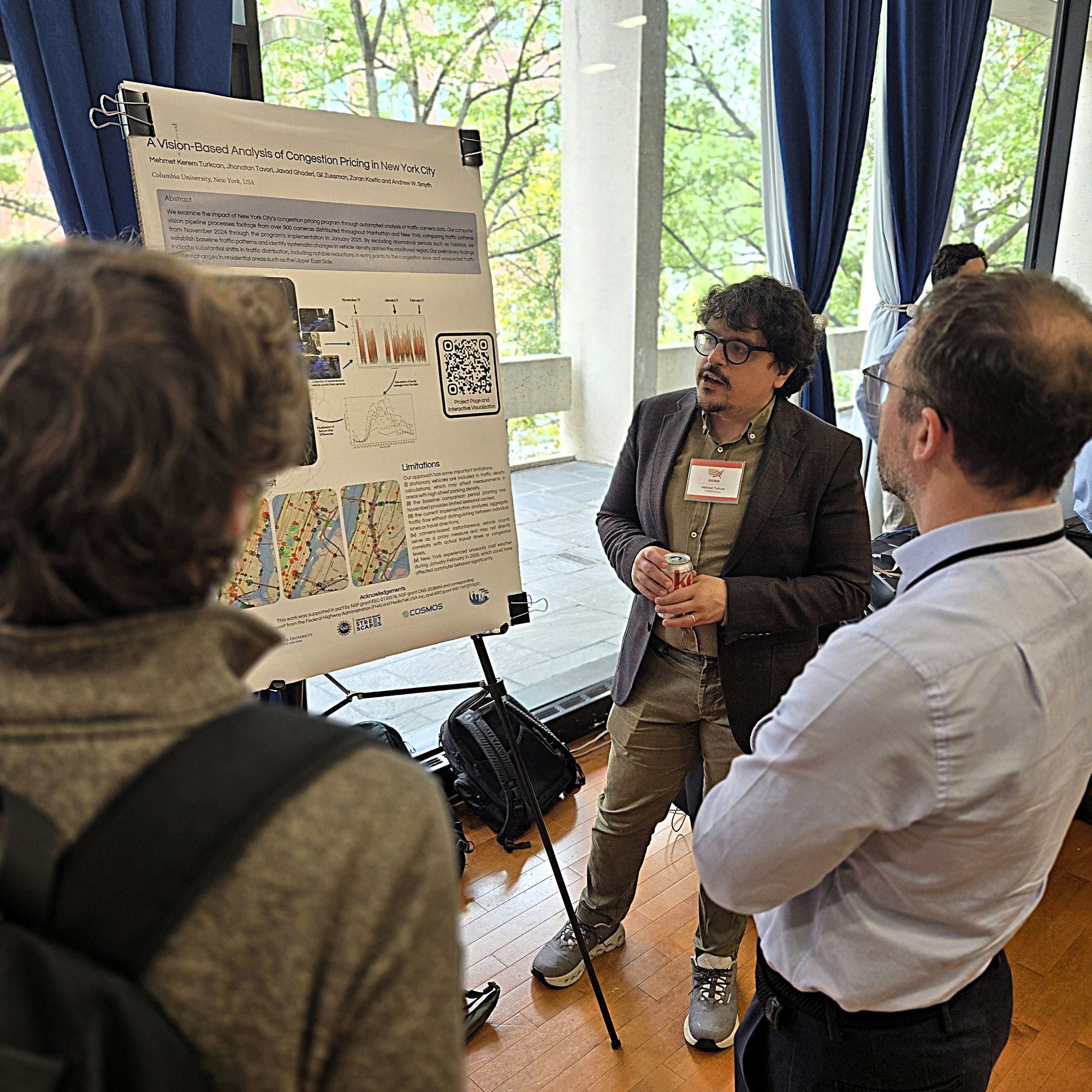
A Vision-Based Analysis of Congestion Pricing in New York City
Poster at the 2026 PAWR PI Meeting on how traffic changed at 910 public cameras after New York City began congestion pricing. Photo: PAWR Project Office.
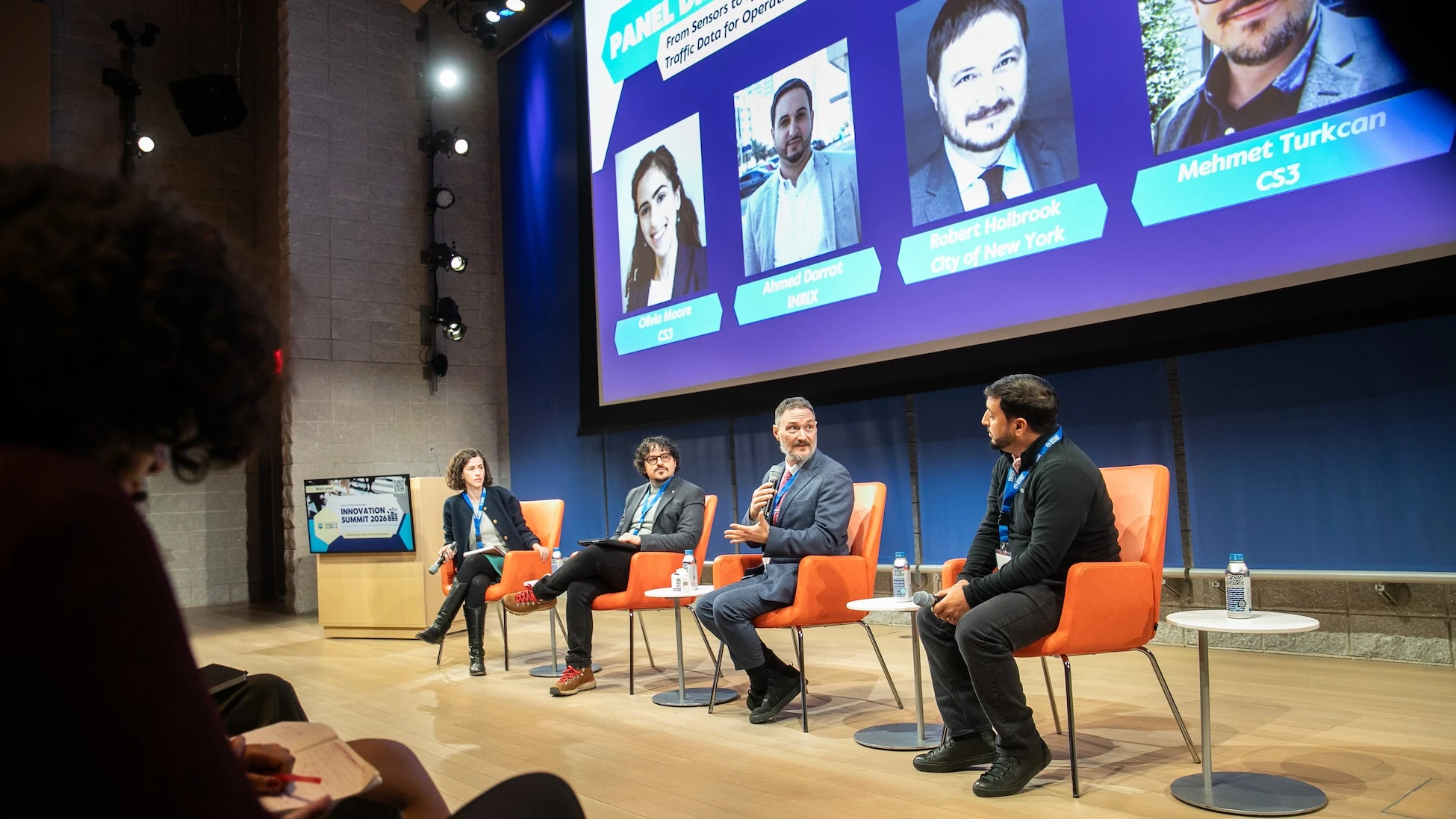
From Sensors to Systems: Real-Time Traffic Analysis for Faster Decision-Making
Panelist at the CS3 Innovation Summit, discussing how camera, mobility, and model outputs become operational urban intelligence.
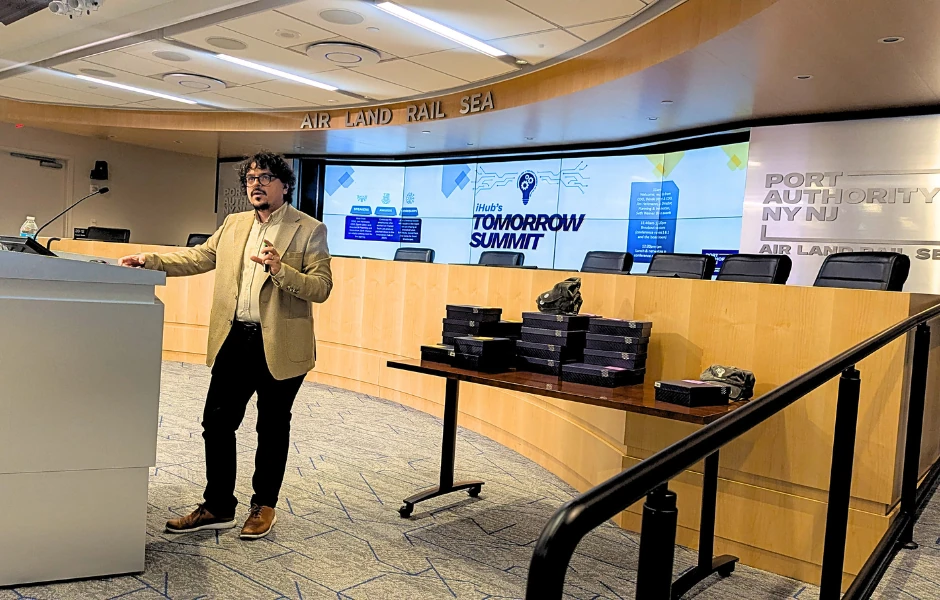
Port Authority Tomorrow Summit workshop
I hosted a technical workshop at the Port Authority of New York and New Jersey headquarters as part of its annual Tomorrow Summit, which recognizes technology pilots demonstrated during the previous year.
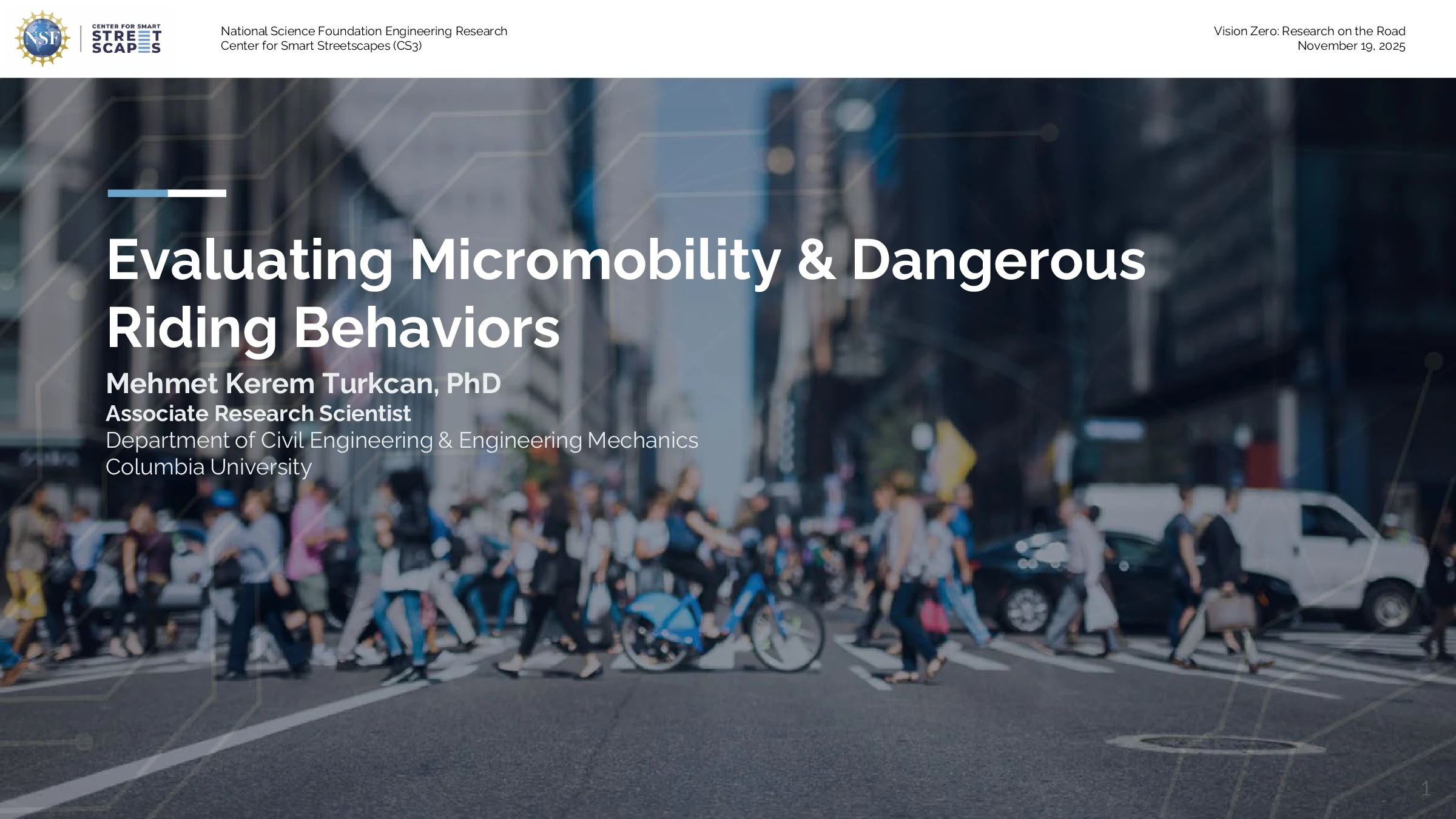
Evaluating Micromobility & Dangerous Riding Behaviors
Presentation at the Eighth Annual Vision Zero Research on the Road event on using street camera analytics to study micromobility and risky riding behavior.