Controlling actors
This tutorial empties W 120th St and Amsterdam Ave of the city's own traffic and controls four actors: a taxi under manual control that stops for the light, a car on autopilot with a planned left turn, a pedestrian steered along a sidewalk route, and a pedestrian sent across the junction by the AI controller. A camera looks straight down on the junction, and the script draws every actor's path over its last frame before it destroys the actors.
The ambient population
original, ambient = world.get_settings(), world.get_ambient_traffic()
world.set_ambient_traffic(vehicles=0, walkers=0)        # API actors only; they are never counted or removed
The city keeps a background population of vehicles and pedestrians around the spectator. set_ambient_traffic sets
its size; 0 empties the streets for a controlled scenario. Actors spawned through the API are never counted in it or
removed by it. The script restores the previous sizes when it exits. Before it spawns anything, it steps the world
until the signals on W 120th St have just turned green: every signal runs the same cycle, so the taxi on the avenue
will meet a red light and the SUV on the street will turn on green.
Manual control and autopilot
manual = spawn("vehicle.taxi2", m.get_waypoint(J.location - up * 55 + east * 4, heading=UPTOWN).transform)
auto = spawn("vehicle.suv", m.get_waypoint(J.location - east * 45, heading=UPTOWN - 90).transform)
auto.set_autopilot(True, route=["left"])            # at the next junction, turn left (uptown)
A spawned vehicle is under manual control until set_autopilot(True). The taxi starts 55 m south of the junction on
a northbound lane of Amsterdam Ave, the SUV 45 m west of it on W 120th St, heading east. On autopilot the SUV follows
its lane and the signals and turns left, uptown, at the junction. The simulation takes the next planned turn at a
junction that offers it; at one that does not, the vehicle chooses its own way and keeps the plan for later.
t = taxi.get_transform()
ahead = (junction.location - t.location).dot(unit(t.rotation.yaw))      # metres to the junction centre
target = cruise
if 11.0 < ahead < 35.0 and world.get_traffic_light_state(t.rotation.yaw).state != "green":
    target = 0.0 if ahead < 13.0 else min(cruise, math.sqrt(2.0 * 2.0 * (ahead - 13.0)))
if target == 0.0:
    return VehicleControl(brake=1.0)
error = target - taxi.get_speed()
if error >= 0:
    return VehicleControl(throttle=min(1.0, 0.3 + 0.3 * error))
return VehicleControl(brake=min(1.0, 0.5 - 0.3 * error))
A manually controlled vehicle moves only by apply_control(VehicleControl(throttle, steer, brake, hand_brake,
reverse)), applied until the next call; it obeys no signals by itself. The controller above holds 7 m/s and, while
the light for its heading is not green, brakes to a stop at the stop line. get_traffic_light_state(yaw) returns the
signal state for traffic travelling at that heading and the time left in it. steer is between -1 and 1, positive to
the right; the taxi drives straight and does not use it.
Direct control and the AI walker controller
_, sidewalk = m.plan_walk_route(J.location - up * 45 - east * 12.5, J.location + up * 30 - east * 12.5)
walker = spawn("walker.pedestrian.0003", Transform(sidewalk[0]))
...
walker.apply_control(WalkerControl(direction=sidewalk[0] - here_w, speed=0.0 if arrived else 1.4))
plan_walk_route returns the length and the points of a route over the sidewalks and crosswalks. The first pedestrian
walks up the west sidewalk of Amsterdam Ave under direct control: on every step the script points its
WalkerControl at the next point of the route, with the direction as a world-frame vector and the speed in m/s.
crosser = spawn("walker.pedestrian.0011", Transform(J.location - up * 14 + east * 14))
ai = world.spawn_actor(lib.find("controller.ai.walker"), Transform(), attach_to=crosser)
ai.start()
route = ai.go_to_location(J.location + up * 14 - east * 14)   # the opposite corner, over two crosswalks
The second pedestrian gets a controller.ai.walker, attached to it like a sensor. go_to_location plans a route and
starts walking it; at each crossing the pedestrian waits at the kerb until the walk signal leaves enough time to cross
and no car is in the way. get_state() reports walking and then arrived.
Destroying actors
Actors stay in the world until they are destroyed, also after the client that spawned them disconnects. Destroying an
actor also destroys the sensors and controllers attached to it. The script destroys everything it spawned in a
finally block, so an interrupted run leaves nothing behind.
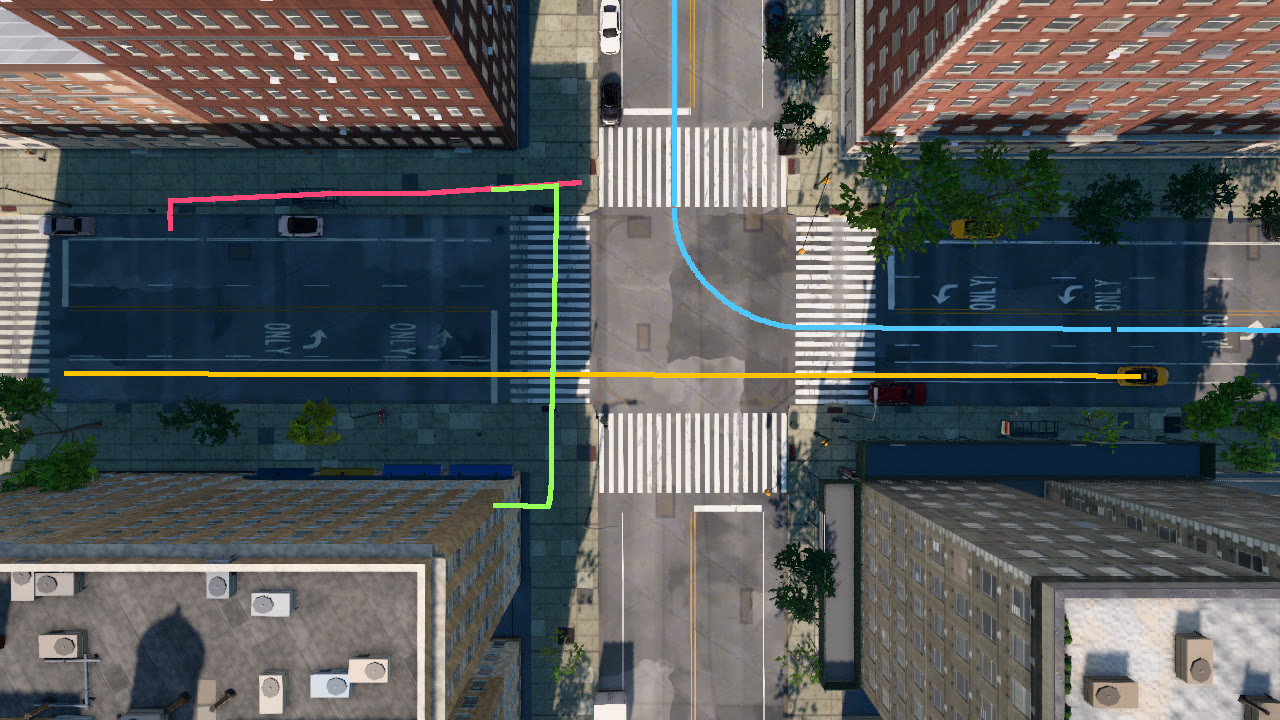
The script prints:
sidewalk route 9 points; AI route 14 points, state walking
t = 0.00 s: taxi 0.2 m/s, light red, AI walker walking
t = 2.00 s: taxi 5.7 m/s, light red, AI walker walking
t = 4.00 s: taxi 7.0 m/s, light red, AI walker walking
t = 6.00 s: taxi 6.0 m/s, light red, AI walker walking
t = 8.00 s: taxi 2.0 m/s, light red, AI walker walking
t = 10.00 s: taxi 0.0 m/s, light red, AI walker walking
t = 12.00 s: taxi 0.0 m/s, light red, AI walker walking
t = 14.00 s: taxi 0.0 m/s, light red, AI walker walking
t = 16.00 s: taxi 0.0 m/s, light red, AI walker walking
t = 18.00 s: taxi 0.0 m/s, light red, AI walker walking
t = 20.00 s: taxi 0.2 m/s, light green, AI walker walking
t = 22.00 s: taxi 5.7 m/s, light green, AI walker walking
t = 24.00 s: taxi 7.0 m/s, light green, AI walker walking
t = 26.00 s: taxi 6.8 m/s, light green, AI walker walking
t = 28.00 s: taxi 6.9 m/s, light green, AI walker walking
travelled: {'manual': 102.9, 'autopilot': 158.1, 'walker': 42.0, 'ai_walker': 42.4}
The complete script
"""Controlling actors at W 120th St and Amsterdam Ave: a taxi under manual control that stops for the light, a car on
autopilot with a planned turn, a pedestrian steered along a sidewalk route, and one sent across the junction by the AI
controller. The streets are emptied of the city's own traffic first. A camera looks straight down on the junction;
the script saves its frames and draws every actor's path over the last one. Needs numpy.
python actors.py [--host 127.0.0.1] [--port 2000] [--seconds 30] [--out _out/actors]
"""
import argparse
import math
import os
import queue
import sys
sys.path.insert(0, os.path.join(os.path.dirname(os.path.abspath(__file__)), "..", "..")) # run from a source checkout
import valdrada # noqa: E402
from valdrada import Location, Rotation, Transform, VehicleControl, WalkerControl # noqa: E402
from valdrada.png import write_png # noqa: E402
from valdrada.util import project_point # noqa: E402
AMSTERDAM_120 = (40.80955, -73.95905) # W 120th St & Amsterdam Ave, Morningside Heights
UPTOWN = 61.0 # Manhattan's avenues run at this yaw (degrees counter-clockwise from east)
DT = 0.05
COLOUR = {"manual": (255, 196, 0), "autopilot": (80, 200, 255), "walker": (255, 70, 120), "ai_walker": (150, 255, 90)}
def unit(yaw):
return Location(math.cos(math.radians(yaw)), math.sin(math.radians(yaw)), 0)
def drive(world, taxi, junction, cruise=7.0):
"""A manual controller: hold `cruise` m/s straight ahead, stop at the line while the light is not green."""
t = taxi.get_transform()
ahead = (junction.location - t.location).dot(unit(t.rotation.yaw)) # metres to the junction centre
target = cruise
if 11.0 < ahead < 35.0 and world.get_traffic_light_state(t.rotation.yaw).state != "green":
target = 0.0 if ahead < 13.0 else min(cruise, math.sqrt(2.0 * 2.0 * (ahead - 13.0)))
if target == 0.0:
return VehicleControl(brake=1.0)
error = target - taxi.get_speed()
if error >= 0:
return VehicleControl(throttle=min(1.0, 0.3 + 0.3 * error))
return VehicleControl(brake=min(1.0, 0.5 - 0.3 * error))
def main():
ap = argparse.ArgumentParser(description=__doc__, formatter_class=argparse.RawDescriptionHelpFormatter)
ap.add_argument("--host", default="127.0.0.1")
ap.add_argument("--port", type=int, default=2000)
ap.add_argument("--seconds", type=float, default=30.0)
ap.add_argument("--out", default="_out/actors")
a = ap.parse_args()
os.makedirs(a.out, exist_ok=True)
client = valdrada.Client(a.host, a.port)
client.set_timeout(120.0)
world = client.get_world()
original, ambient = world.get_settings(), world.get_ambient_traffic()
world.apply_settings(valdrada.WorldSettings(synchronous_mode=True, fixed_delta_seconds=DT))
world.set_ambient_traffic(vehicles=0, walkers=0) # API actors only; they are never counted or removed
m = world.get_map()
here = m.geolocation_to_location(*AMSTERDAM_120)
world.get_spectator().set_transform(Transform(here + Location(0, 0, 30)))
world.wait_until_loaded()
J = m.get_junctions(center=here, radius=60)[0]
lib = world.get_blueprint_library()
up, east = unit(UPTOWN), unit(UPTOWN - 90) # up the avenue, and along the street towards the east
actors = []
# every signal runs the same cycle: start as W 120th St turns green, so that the taxi on the avenue meets a red
while True:
light = world.get_traffic_light_state(UPTOWN - 90)
if light.state == "green" and light.time_left > 12.0:
break
world.tick()
def spawn(bp_id, transform):
actor = world.spawn_actor(lib.find(bp_id), transform)
actors.append(actor)
return actor
try:
# vehicles: spawn on a lane pose from the map; manual until set_autopilot(True)
manual = spawn("vehicle.taxi2", m.get_waypoint(J.location - up * 55 + east * 4, heading=UPTOWN).transform)
auto = spawn("vehicle.suv", m.get_waypoint(J.location - east * 45, heading=UPTOWN - 90).transform)
auto.set_autopilot(True, route=["left"]) # at the next junction, turn left (uptown)
# pedestrians: one steered directly along a sidewalk route, one routed by the AI controller
_, sidewalk = m.plan_walk_route(J.location - up * 45 - east * 12.5, J.location + up * 30 - east * 12.5)
walker = spawn("walker.pedestrian.0003", Transform(sidewalk[0]))
crosser = spawn("walker.pedestrian.0011", Transform(J.location - up * 14 + east * 14))
ai = world.spawn_actor(lib.find("controller.ai.walker"), Transform(), attach_to=crosser)
actors.append(ai)
ai.start()
route = ai.go_to_location(J.location + up * 14 - east * 14) # the opposite corner, over two crosswalks
print(f"sidewalk route {len(sidewalk)} points; AI route {len(route)} points, state {ai.get_state()}")
# a camera 80 m above the junction looking straight down, the avenue running left to right
bp = lib.find("sensor.camera.rgb")
bp.set_attribute("fov", 75)
cam = world.spawn_actor(bp, Transform(J.location + Location(0, 0, 80), Rotation(pitch=-90, yaw=UPTOWN + 90)))
actors.append(cam)
frames = queue.Queue()
cam.listen(frames.put)
tracked = {"manual": manual, "autopilot": auto, "walker": walker, "ai_walker": crosser}
paths = {k: [] for k in tracked}
for step in range(int(a.seconds / DT)):
manual.apply_control(drive(world, manual, J))
here_w = walker.get_location()
while len(sidewalk) > 1 and here_w.distance_2d(sidewalk[0]) < 0.8:
sidewalk.pop(0)
arrived = len(sidewalk) == 1 and here_w.distance_2d(sidewalk[0]) < 0.8
walker.apply_control(WalkerControl(direction=sidewalk[0] - here_w, speed=0.0 if arrived else 1.4))
frame = world.tick()
image = frames.get(timeout=30)
for k, actor in tracked.items():
paths[k].append(actor.get_location())
if step % 40 == 0:
image.save_to_disk(os.path.join(a.out, f"top_{frame:06d}.png"))
print(f"t = {step * DT:5.2f} s: taxi {manual.get_speed():4.1f} m/s, "
f"light {world.get_traffic_light_state(UPTOWN).state}, AI walker {ai.get_state()}")
# every actor's path, projected into the last top-down frame
img = image.to_numpy()[..., :3].copy()
for k, pts in paths.items():
for p in pts:
uv = project_point(p, image.transform, image.width, image.height, image.fov)
if uv and 0 <= uv[0] < image.width and 0 <= uv[1] < image.height:
x, y = int(uv[0]), int(uv[1])
img[max(0, y - 2):y + 3, max(0, x - 2):x + 3] = COLOUR[k]
write_png(os.path.join(a.out, "paths.png"), image.width, image.height, img.tobytes(), 3)
print("travelled:", {k: round(sum(p.distance(q) for p, q in zip(pts, pts[1:])), 1) for k, pts in paths.items()})
finally:
for actor in reversed(actors):
    actor.destroy()
world.set_ambient_traffic(vehicles=ambient["vehicles"], walkers=ambient["walkers"])
world.apply_settings(original)
if __name__ == "__main__":
main()