Rendering in Unreal Engine 5
A shot exported to OpenUSD for Blender Cycles can also be rendered with Unreal Engine 5.8: the same USD, imported with Unreal's USD Stage importer and rendered with Lumen, hardware ray tracing and Movie Render Queue. A 108 frame take renders in about 5 minutes including the import (0.13 to 0.23 s a frame, against 6.9 to 8.5 s a frame in Cycles), and the cinematic preset adds temporal accumulation, depth of field and a film look. How the two renderers share the export is described in One city, three renderers.
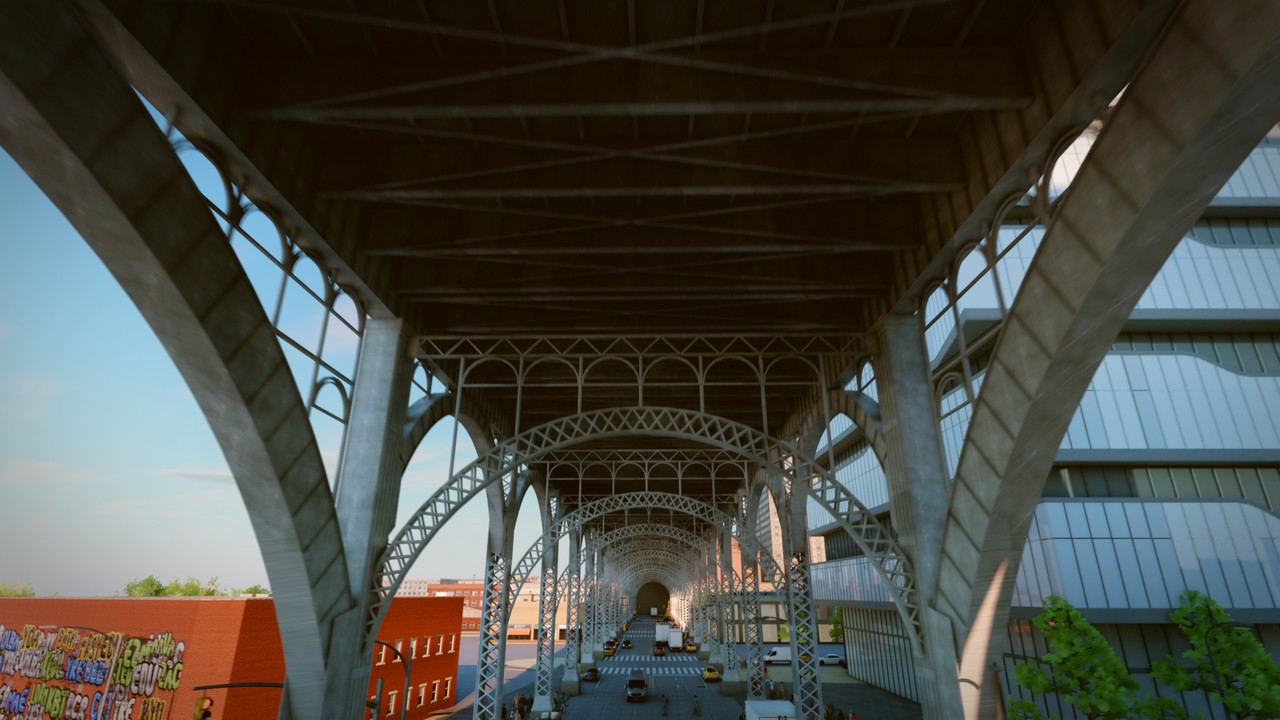
This guide installs the engine, prepares the project and the material sets, renders t7ArchSoffit (the shot of the
Cycles guide), gives the measured times and lists the known limits. The commands are written for a Linux shell.
What you need
| Item | Requirement |
|---|---|
| Operating system | Linux x86-64; the takes below were rendered on Ubuntu 22.04 |
| GPU | an NVIDIA RTX GPU with the proprietary driver and Vulkan (tested on RTX 6000 Ada, 48 GB, driver 580) |
| Engine | Unreal Engine 5.8 (tested with 5.8.3 built from source) |
| Disk | about 200 GB for the engine built from source (197 GB measured); the take's harvest and USD as in the Cycles guide |
| Export tools | a source checkout with the client, Playwright's Chromium, Python 3.8 or later and uv, as in the Cycles guide |
| Assets | the street tree set Blender/bxtrees2 from the dataset, and the CC0 material sets (below) |
Get Unreal Engine 5.8
The engine is licensed by Epic Games under the Unreal Engine End User License Agreement (https://www.unrealengine.com/eula). Linking accounts and accepting the agreement are steps you take yourself, under your own Epic Games account.
Linux, from source. Epic publishes the source in the private EpicGames/UnrealEngine repository on GitHub. To get
access, sign in at epicgames.com, link your GitHub account under your account's apps and accounts settings, accept the
licence agreement there, and accept the invitation to the EpicGames organisation that GitHub then sends. Then:
git clone --depth 1 --branch 5.8.3-release https://github.com/EpicGames/UnrealEngine.git UE_5.8
cd UE_5.8
./Setup.sh
./GenerateProjectFiles.sh
make UnrealEditor
for t in ShaderCompileWorker UnrealPak CrashReportClient InterchangeWorker; do make $t; done
export UE_ROOT=$PWD
Setup.sh downloads the engine's binary dependencies. The editor target builds every engine plugin, including the
ones the project needs (USD importer, Movie Render Queue, Python scripting, editor and sequencer scripting), so the
project has no build of its own. The helper targets are built one at a time because the build tool runs one instance
per engine. On a machine with 128 hardware threads the editor build took 16 minutes.
Windows, from the launcher. The Epic Games Launcher installs a binary build: Unreal Engine, Library, Engine
Versions, add version 5.8. Set UE_ROOT to the installed engine folder. ue_take.py starts the editor from
Engine/Binaries/Win64 on Windows and from Engine/Binaries/Linux elsewhere. The take scripts have been tested on Linux
only; on Windows the engine renders with Direct3D 12 instead of Vulkan, so expect small differences and report
problems.
The project
client/tools/ar34/export/ue_project/ is the Unreal project the takes use:
| File | Contents |
|---|---|
BoundlessUE.uproject |
the plugins: USD importer, Movie Render Pipeline, Python script plugin, editor scripting utilities, sequencer scripting |
Config/DefaultEngine.ini |
Lumen, Nanite, virtual shadow maps, MegaLights for the street lamps, hardware ray tracing on Vulkan SM6 |
Python/ue_masters.py |
the master materials, one per material family of the export, as Custom HLSL nodes, built into /Game/Bx/ on the first import |
Python/ue_foliage.py |
the masters of the tree set: geometry leaves, alpha-tested leaf cards and bark |
Content/, Saved/, Intermediate/ and DerivedDataCache/ are generated and kept out of git. Nothing in the project
needs to be opened by hand: ue_take.py runs the editor in its command line mode for the import and the engine in
-game mode for the render. Set these variables in every shell you use below:
export UE_ROOT=~/UE_5.8                 # the engine
export BXUE_DDC=~/bx/ue_ddc             # a writable folder for the engine's local derived data cache
export BXTREES_ASSETS=$PWD/.cache/hf/Blender/bxtrees2
The tree set comes from the dataset, as in the Cycles guide:
hf download mehmetkeremturkcan/valdrada --repo-type dataset --revision v0.3.1 --include "Blender/bxtrees2/*" --local-dir .cache/hf
Fetch the CC0 material sets
Unreal draws the asphalt, the sidewalks, the kerbs, the walls by material and the viaducts' steel with 13 CC0 material
sets from Poly Haven at 4K, layered over the export's own materials. tools/assets/fetch_hq.py downloads them (371 MB)
and writes hq.json, which records for each set its source page, licence, real size in metres, files and mean albedo:
Then point the takes at the sets with export BXUE_HQ=~/bx/hq/hq.json (otherwise "manifest" under "hq" in
client/tools/ar34/export/ue_families.json is used, which names the folder of the development machine). That
table maps each pbrLib set, ground kind, viaduct
layer and facade wall class to its set. A take rendered without the sets, or with BXUE_NOHQ=1, uses the export's own
textures.
Export the shot
The Unreal take renders the USD that the Cycles guide writes. Follow its sections
Capture the shot and Write the USD, with
BXTREES_ASSETS set as above, so that ~/bx/u/t7ArchSoffit.usda exists. A USD already rendered with Cycles needs no
new export.
Render the take
python3 client/tools/ar34/export/ue_take.py --usd ~/bx/u/t7ArchSoffit.usda \
    --outdir ~/bx/ue/t7ArchSoffit --work ~/bx/ue_work/t7ArchSoffit --res 2560x1440 --gpu 0
The script runs three stages, each in its own process:
- Prep.
ue_prep.pywrites the take's Unreal layer: the per-vertex data packed into UV sets, the moving vehicles, trains and signal lenses as animated transforms, andue_t7ArchSoffit.jsonwith the materials' tags. - Import.
UnrealEditor-Cmdbuilds the master materials when they are missing, imports the stage into/Game/Takes/t7ArchSoffit/(Nanite meshes, actors, the camera and the moving sets as Level Sequence tracks), makes each tagged material an instance of its family's master, sets up the sun, the sky, the street and vehicle lamps and the film look, and writes the Movie Render Queue job. A fingerprint of the take's layers is kept beside the import, so rendering the same USD again reuses it (--reimportimports it again). - Render. The engine renders the frames off screen into
~/bx/ue/t7ArchSoffit/frame_%05d.jpg, with the planar depth in_depth/and the regions of the data pass in_ue/regions/.take_ue.jsonin the same folder records the times of every stage; the logs of the stages (prep.log,import.log,render.log) are in the work folder.
--gpu picks the Vulkan device. Existing frames are kept unless --overwrite is given. --light web replaces the
physical light (the default, shared with Cycles through phys_light.json) by the rig calibrated against the web takes,
and --treewind 0 freezes the trees' wind.
The cinematic preset. --cine renders 8 temporal samples per frame over a 180 degree shutter centred on the frame,
with depth of field on the subject at f/2.8 (--fstop), the client's bloom, film grain (--grain), a deeper vignette,
light volumetric fog by day (--fog) and the analytic haze at night:
python3 client/tools/ar34/export/ue_take.py --usd ~/bx/u/t7ArchSoffit.usda \
    --outdir ~/bx/ue/t7ArchSoffit --work ~/bx/ue_work/t7ArchSoffit --res 2560x1440 --gpu 0 --cine
ffmpeg -framerate 30 -i ~/bx/ue/t7ArchSoffit/frame_%05d.jpg -c:v libx264 -crf 16 -pix_fmt yuv420p ~/bx/t7ArchSoffit_ue.mp4
Batches. bx_render_all.mjs renders a list of shots with Unreal and the same checks as the Cycles takes. It writes
the harvest and the USD when a shot has none, or reuses a Cycles batch's with --usdfrom <work dir>:
node client/tools/ar34/export/bx_render_all.mjs --target ue --shots t7ArchSoffit --gpus 0 \
    --work ~/bx/ue_batch --clips ~/bx/ue_takes --nopreview --nocut --uetake " --cine"
The value of --uetake (extra ue_take.py options) begins with a space so that it is not read as an option of the
batch. --cycref <dir> names the root of physical Cycles takes of the same shots, which ue_check.py then compares
region by region. After the summary the batch prints the coverage report
of every shot's USD.
Times
Measured on RTX 6000 Ada GPUs at 2560 × 1440, 108 frame takes with the bxtrees2 trees:
| Stage | Default | Cinematic (--cine) |
|---|---|---|
| Prep | 9 to 20 s | 9 to 20 s |
| Import, first time | 146 to 389 s | 146 to 389 s |
| Import, the same USD again | 40 to 95 s | 40 to 95 s |
| Render, per frame | 0.13 to 0.23 s | 1.05 to 1.25 s |
| Whole take | 4.7 to 5.6 min | 5.5 to 13 min |
For t7ArchSoffit with --cine: prep 20 s, import 364 s, the render 178 s (the first frame 43 s with the engine start
and 48 warm-up frames, then a median of 1.14 s a frame) and 67 s to write the frames. The first take on a machine also
compiles the engine's global shaders and builds the tree set's Nanite meshes (about 4.5 minutes); the derived data cache
keeps both. For comparison, the physical light Cycles takes of the same shots needed 6.9 to 8.5 s a frame.
Known limits
| Limit | Detail |
|---|---|
| Contiguous takes | Render a take's frames as one range. A render that jumped from frame 0 to frame 54 has hung the GPU, so final batches use --nopreview, whose three preview frames are not contiguous. |
| Walkers and wind outside ray tracing | The walkers' skinned meshes are left out of the ray tracing scene and the trees' wind is not evaluated for ray tracing: Lumen lights and reflects the scene without the walkers (the sun's shadow maps still cast their shadows) and sees the crowns at rest. Both changes, with async compute off, stopped a GPU hang during takes. BXUE_RTDYN=1 restores them, for tests. |
| Sign lights | At night the lit signs and shop interiors light their surroundings as rect lights. One shot lost the GPU device three times with them and was rendered with BXUE_EMITK=0, which turns them off. |
| Linux only | See Get Unreal Engine 5.8. |
Credits in films
A film rendered with Unreal Engine that has credits must carry the notices of the Unreal Engine End User License Agreement in its credits, with the film's title and the current year:
<Title> uses Unreal® Engine. Unreal® is a trademark or registered trademark of Epic Games, Inc. in the United States
of America and elsewhere.
Unreal® Engine, Copyright 1998 – 2026, Epic Games, Inc. All rights reserved.
Common problems
| Problem | Fix |
|---|---|
The render exits at once with Vulkan errors in render.log |
Install the NVIDIA driver's Vulkan component; ue_take.py selects NVIDIA's Vulkan driver when /usr/share/vulkan/icd.d/nvidia_icd.json exists. |
core option ... missing in this engine |
The engine is not 5.8: the import refuses an engine whose USD importer or Movie Render Queue lacks an option the take needs. |
| Materials render flat or white | The masters were not built: look for [bxue] errors in import.log in the work folder. |
| Plain asphalt and walls | The CC0 sets were not fetched, or neither BXUE_HQ nor hq.manifest in ue_families.json points to hq.json. |
| The trees are the client's | BXTREES_ASSETS was not set when the USD was written. |