Semantic and instance segmentation
This tutorial places an RGB camera, a semantic segmentation camera and an instance segmentation camera at one pose, 16 m above the west side of Lenox Ave south of W 125th St, looking up the avenue. It saves the class mask in its palette and as raw class ids, the instance codes with the labels of every object in view, and a view with one colour per object.
Label cameras
pose = Transform(junction.location + Location(-45, -40, 16), Rotation(pitch=-14, yaw=42))
for kind in ("rgb", "semantic_segmentation", "instance_segmentation"):
    bp = lib.find("sensor.camera." + kind)
    bp.set_attribute("fov", 75)
    cam = world.spawn_actor(bp, pose)
    cam.listen(lambda data, kind=kind: latest.__setitem__(kind, data))
Cameras with the same parent, transform, field of view and image size share one capture per step: the server renders
the view once and renders the label images from the same scene state, so the masks register with the RGB image.
The three events carry the same frame number, which the script checks. Label cameras render at the server's resolution
unless image_size_x and image_size_y say otherwise.
Semantic segmentation
sem.save_to_disk(os.path.join(a.out, "semantic.png"))                      # class palette
sem.save_to_disk(os.path.join(a.out, "semantic_ids.png"), colorize=False)  # one byte per pixel: the class id
ids = sem.to_numpy()                                   # (H, W) uint8 class ids
A SemanticSegmentationImage holds one class id per pixel. to_numpy() returns them as an H × W array of
uint8, save_to_disk writes them either in the class palette (colorize=True, the default) or as an 8-bit
grey image of the ids, the format to train on. world.get_semantic_classes() returns the class table; the colours
follow Cityscapes where the classes overlap.
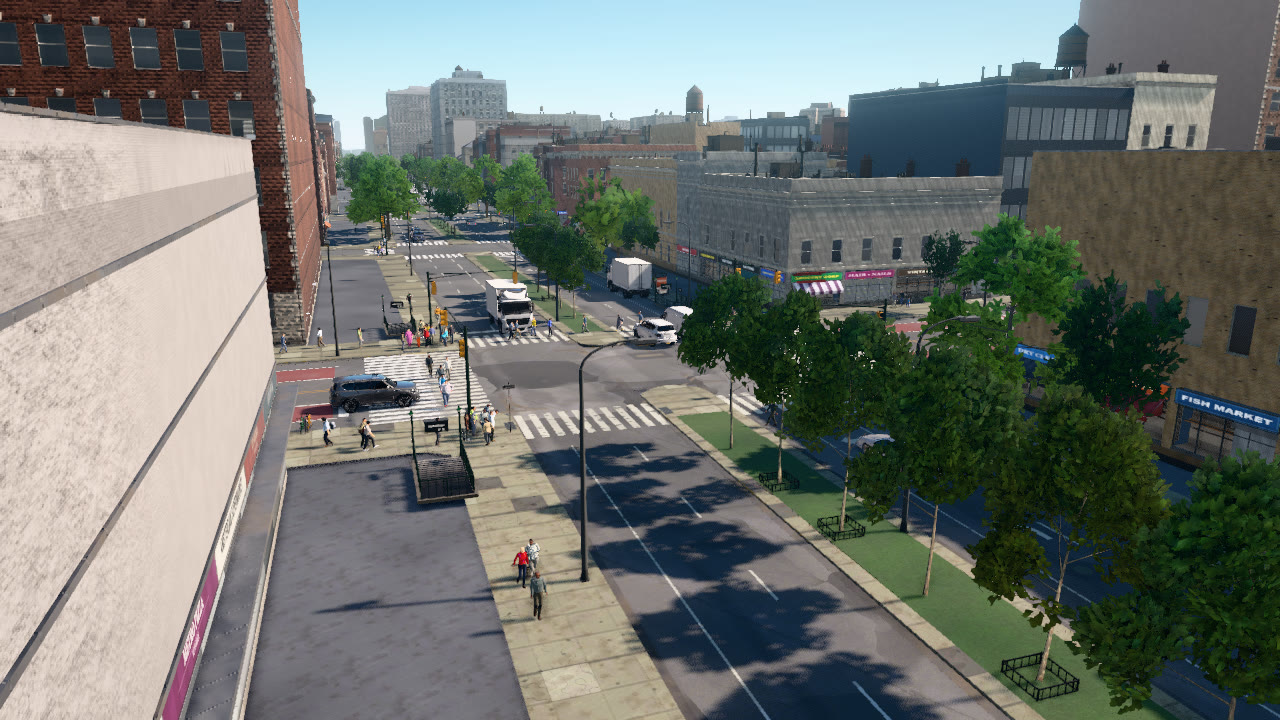
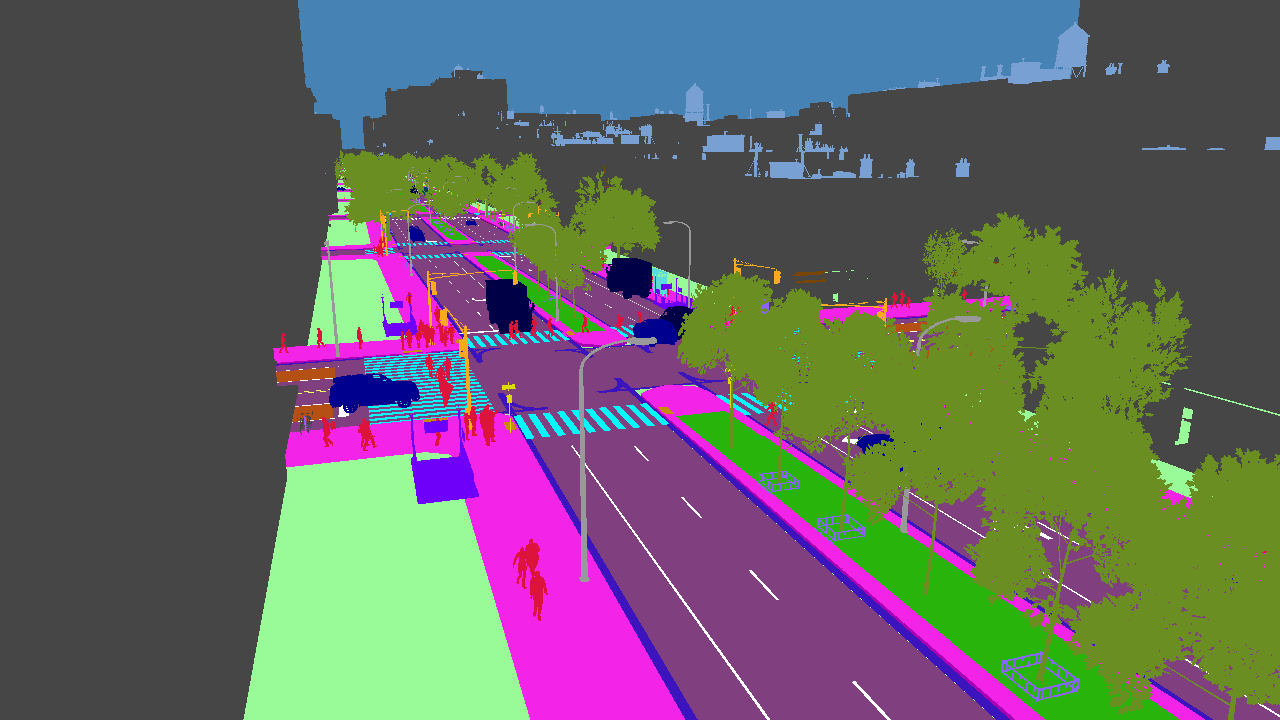
The classes, their palette colours, and whether their objects receive instance ids:
| id | class | colour | instances |
|---|---|---|---|
| 0 | unlabeled |
0, 0, 0 | |
| 1 | sky |
70, 130, 180 | |
| 2 | building |
70, 70, 70 | yes |
| 3 | road |
128, 64, 128 | |
| 4 | sidewalk |
244, 35, 232 | |
| 5 | curb |
170, 0, 180 | |
| 6 | road_marking |
255, 255, 255 | |
| 7 | crosswalk |
0, 250, 250 | |
| 8 | lane_marking_yellow |
250, 255, 100 | |
| 9 | bike_lane |
0, 230, 60 | |
| 10 | bus_lane |
180, 80, 20 | |
| 11 | gutter |
60, 20, 190 | |
| 12 | detectable_warning |
200, 140, 0 | |
| 13 | plaza |
170, 150, 70 | |
| 14 | footpath |
230, 200, 180 | |
| 15 | terrain |
152, 251, 152 | |
| 16 | grass |
40, 180, 10 | |
| 17 | vegetation |
107, 142, 35 | yes |
| 18 | water |
30, 80, 160 | |
| 19 | car |
0, 0, 142 | yes |
| 20 | bus |
0, 60, 100 | yes |
| 21 | truck |
0, 0, 70 | yes |
| 22 | bicycle |
119, 11, 32 | yes |
| 23 | pedestrian |
220, 20, 60 | yes |
| 24 | traffic_signal |
250, 170, 30 | yes |
| 25 | pedestrian_signal |
210, 90, 190 | yes |
| 26 | street_sign |
220, 220, 0 | yes |
| 27 | street_light |
153, 153, 153 | yes |
| 28 | hydrant |
230, 110, 80 | yes |
| 29 | street_furniture |
140, 100, 250 | yes |
| 30 | bus_shelter |
90, 220, 220 | yes |
| 31 | subway_entrance |
110, 0, 250 | yes |
| 32 | scaffold |
210, 180, 90 | yes |
| 33 | building_appurtenance |
120, 70, 0 | yes |
| 34 | roof_structure |
120, 160, 210 | yes |
| 35 | bridge |
20, 170, 120 |
Instance segmentation
inst.save_to_disk(os.path.join(a.out, "instance.png"))    # 24-bit instance codes + instance.json
iid = inst.instance_ids()                                  # (H, W) uint32
pixels = int(inst.mask(label).sum())                       # the object's mask from the id image
An InstanceSegmentationImage encodes an instance id in the red, green and blue bytes of every pixel, and carries a
label for every object in view (inst.labels, a list of ObjectLabel). instance_ids() decodes the image into
an H × W array of ids, 0 where a pixel belongs to no object (the sky and the ground classes); mask(label) returns
one object's boolean mask. save_to_disk writes the codes as a lossless PNG and the labels as JSON next to it
(instance.json). Each label has the object's id, class, visible box and pixel count (area), the id of the API
actor it belongs to (0 for the city's own objects), and the object's 3D pose where it is known; the
bounding boxes tutorial uses those. An object keeps its id from frame to frame, so the ids also
serve as track ids.
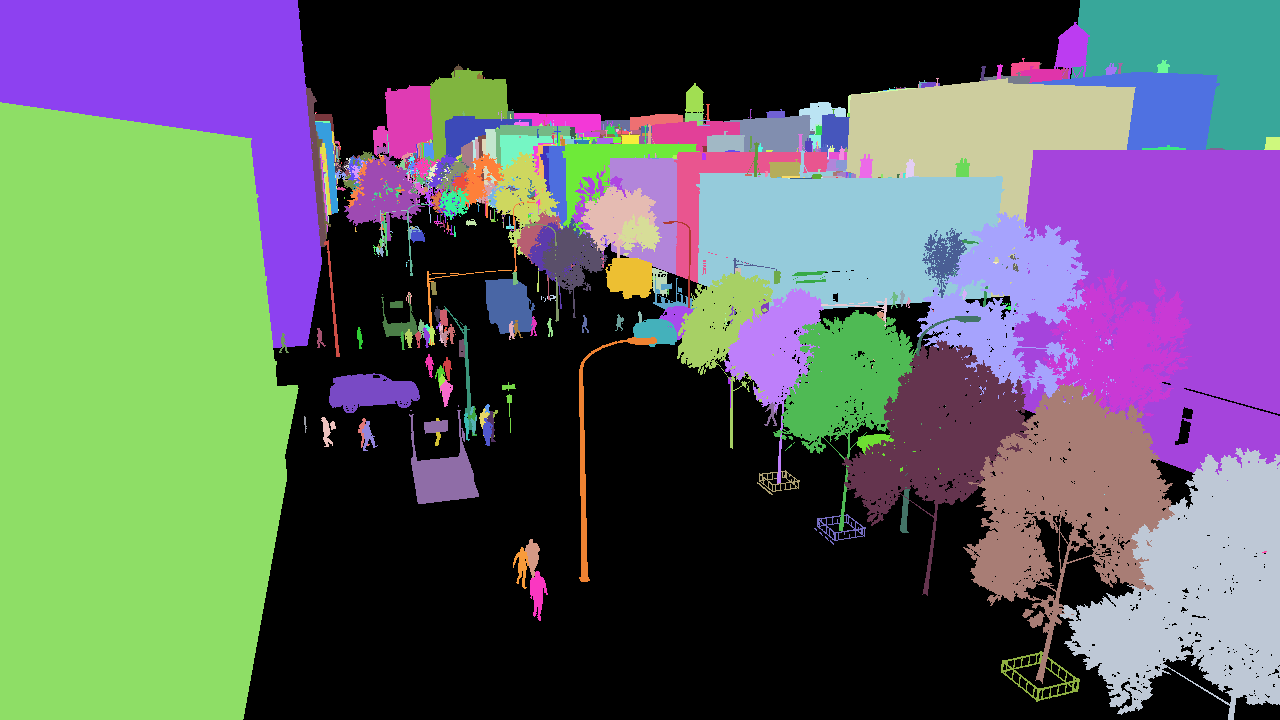
The script prints the classes in view by their share of the image, and the largest objects with their visible box, their area from the labels and the pixel count of their mask:
classes in view:
   2 building               rgb (70, 70, 70)   41.6 %
  17 vegetation             rgb (107, 142, 35)   16.5 %
   3 road                   rgb (128, 64, 128)   11.5 %
   1 sky                    rgb (70, 130, 180)    8.2 %
  15 terrain                rgb (152, 251, 152)    7.2 %
   4 sidewalk               rgb (244, 35, 232)    6.3 %
  16 grass                  rgb (40, 180, 10)    3.0 %
  11 gutter                 rgb (60, 20, 190)    1.0 %
  34 roof_structure         rgb (120, 160, 210)    0.9 %
   7 crosswalk              rgb (0, 250, 250)    0.6 %
  23 pedestrian             rgb (220, 20, 60)    0.5 %
  31 subway_entrance        rgb (110, 0, 250)    0.4 %
  21 truck                  rgb (0, 0, 70)    0.4 %
  19 car                    rgb (0, 0, 142)    0.4 %
  27 street_light           rgb (153, 153, 153)    0.3 %
   6 road_marking           rgb (255, 255, 255)    0.2 %
   5 curb                   rgb (170, 0, 180)    0.2 %
  29 street_furniture       rgb (140, 100, 250)    0.2 %
  24 traffic_signal         rgb (250, 170, 30)    0.2 %
  10 bus_lane               rgb (180, 80, 20)    0.2 %
243 labelled objects; the largest:
  id 156436 building       bbox [0, 102, 299, 618]  area 160876  mask 160876
  id 156283 building       bbox [1012, 150, 268, 331]  area 54634  mask 54634
  id  65723 building       bbox [0, 0, 322, 348]  area 48698  mask 48698
  id    244 vegetation     bbox [1060, 448, 220, 272]  area 34235  mask 34235
  id 156364 building       bbox [696, 171, 309, 139]  area 31611  mask 31611
  id    247 vegetation     bbox [963, 384, 212, 300]  area 27766  mask 27766
  id  65724 building       bbox [846, 78, 290, 219]  area 23478  mask 23478
  id  65732 building       bbox [1071, 0, 209, 150]  area 19342  mask 19342
The complete script
"""Semantic and instance segmentation: RGB, semantic and instance cameras at one pose above W 125th St and Lenox Ave.
Saves the class-palette mask, the raw class ids, the instance codes with their labels, and a colour-per-instance view;
prints the classes in view and the largest objects. Needs numpy.

    python segmentation.py [--host 127.0.0.1] [--port 2000] [--out _out/segmentation]
"""
import argparse
import json
import os
import sys

import numpy as np

sys.path.insert(0, os.path.join(os.path.dirname(os.path.abspath(__file__)), "..", ".."))   # run from a source checkout
import valdrada  # noqa: E402
from valdrada import Location, Rotation, Transform  # noqa: E402
from valdrada.png import write_png  # noqa: E402

LENOX_125 = (40.80776, -73.94549)          # W 125th St & Lenox Ave, Harlem


def main():
    ap = argparse.ArgumentParser(description=__doc__, formatter_class=argparse.RawDescriptionHelpFormatter)
    ap.add_argument("--host", default="127.0.0.1")
    ap.add_argument("--port", type=int, default=2000)
    ap.add_argument("--out", default="_out/segmentation")
    a = ap.parse_args()
    os.makedirs(a.out, exist_ok=True)

    client = valdrada.Client(a.host, a.port)
    client.set_timeout(120.0)
    world = client.get_world()
    original = world.get_settings()
    world.apply_settings(valdrada.WorldSettings(synchronous_mode=True, fixed_delta_seconds=0.05))
    m = world.get_map()
    here = m.geolocation_to_location(*LENOX_125)
    world.get_spectator().set_transform(Transform(here + Location(0, 0, 30)))
    world.wait_until_loaded()
    junction = m.get_junctions(center=here, radius=40)[0]

    # three cameras with the same pose and field of view share one capture per tick
    pose = Transform(junction.location + Location(-45, -40, 16), Rotation(pitch=-14, yaw=42))
    lib = world.get_blueprint_library()
    latest, cameras = {}, []
    for kind in ("rgb", "semantic_segmentation", "instance_segmentation"):
        bp = lib.find("sensor.camera." + kind)
        bp.set_attribute("fov", 75)
        cam = world.spawn_actor(bp, pose)
        cam.listen(lambda data, kind=kind: latest.__setitem__(kind, data))
        cameras.append(cam)

    try:
        for _ in range(40):
            world.tick()
        rgb, sem, inst = latest["rgb"], latest["semantic_segmentation"], latest["instance_segmentation"]
        assert rgb.frame == sem.frame == inst.frame          # the three images are of the same step
        rgb.save_to_disk(os.path.join(a.out, "rgb.png"))
        sem.save_to_disk(os.path.join(a.out, "semantic.png"))                      # class palette
        sem.save_to_disk(os.path.join(a.out, "semantic_ids.png"), colorize=False)  # one byte per pixel: the class id
        inst.save_to_disk(os.path.join(a.out, "instance.png"))                     # 24-bit instance codes + instance.json

        classes = world.get_semantic_classes()                 # [{id, name, rgb, isthing}]
        with open(os.path.join(a.out, "classes.json"), "w", encoding="utf-8") as f:
            json.dump(classes, f, indent=1)
        ids = sem.to_numpy()                                   # (H, W) uint8 class ids
        share = np.bincount(ids.ravel(), minlength=256) / ids.size
        print("classes in view:")
        for c in sorted(classes, key=lambda c: -share[c["id"]]):
            if share[c["id"]] >= 0.001:
                print(f"  {c['id']:2d} {c['name']:22s} rgb {tuple(c['rgb'])}  {100 * share[c['id']]:5.1f} %")

        # per-instance ids (0: stuff and background); one random colour per object
        iid = inst.instance_ids()                              # (H, W) uint32
        uniq, inverse = np.unique(iid, return_inverse=True)
        colours = np.random.default_rng(7).integers(48, 256, size=(len(uniq), 3), dtype=np.uint8)
        colours[uniq == 0] = 0
        vis = colours[inverse.reshape(iid.shape)]
        write_png(os.path.join(a.out, "instance_colors.png"), inst.width, inst.height, np.ascontiguousarray(vis).tobytes(), 3)

        print(f"{len(inst.labels)} labelled objects; the largest:")
        for label in sorted(inst.labels, key=lambda l: -l.area)[:8]:
            pixels = int(inst.mask(label).sum())               # the object's mask from the id image
            print(f"  id {label.id:6d} {label.class_name:14s} bbox {label.bbox}  area {label.area}  mask {pixels}")
    finally:
        for cam in cameras:
            cam.destroy()
        world.apply_settings(original)


if __name__ == "__main__":
    main()