Recording a dataset
This tutorial fills W 120th St and Amsterdam Ave with autopilot vehicles and walking pedestrians and records them with a pole camera rig: synchronized RGB, semantic segmentation, instance segmentation with labels, and depth, once per simulated second. It writes a COCO detection file for the road users and a contact sheet of the recorded frames.
python PythonAPI/examples/tutorials/record_dataset.py [--frames 24] [--every 20] [--vehicles 20] [--walkers 40]
Traffic and pedestrians
spawn_points = m.get_spawn_points(center=junction.location, radius=120, spacing=16)
...
v = world.try_spawn_actor(rng.choice(vehicle_bps), sp)
if v is not None:
    v.set_autopilot(True)
...
ai = world.spawn_actor(lib.find("controller.ai.walker"), Transform(), attach_to=w)
ai.start()
ai.set_max_speed(rng.uniform(1.1, 1.6))
ai.go_to_location(rng.choice(corners))
get_spawn_points returns poses on lane centres within a radius, spaced along each lane and facing the direction of
travel; try_spawn_actor returns None instead of raising when a spawn fails. The pedestrians start at the corners of
the junction, and an AI controller walks each of them to another corner over the sidewalks and crosswalks, waiting at
the kerb for a walk signal long enough to cross. The script sends a pedestrian that has arrived to a new corner. The
city's own ambient traffic stays on, so the frames contain both the actors spawned here and the background population;
labels tell them apart by actor_id. The script runs 6 s of simulation before it records, so that the traffic spreads
out.
A synchronized rig
for kind in ("rgb", "semantic_segmentation", "instance_segmentation", "depth"):
    bp = lib.find("sensor.camera." + kind)
    bp.set_attribute("fov", 70)
    bp.set_attribute("sensor_tick", a.every * DT)
    if kind == "instance_segmentation":
        bp.set_attribute("amodal", 8)
    cam = world.spawn_actor(bp, pose)
The four cameras share one pose, so each capture renders the view once and derives every output from the same scene
state. sensor_tick sets the simulated time between captures: with 1 s the rig captures on every twentieth step and
adds nothing to the steps in between, while the simulation keeps its 0.05 s step. After each tick() the rig's
events for that step have arrived, or none have when the rig was not due; the script checks the RGB queue and asserts
that the four outputs carry the same frame number.
Output
rgb.save_to_disk(os.path.join(a.out, "rgb", name + ".png"))
sem.save_to_disk(os.path.join(a.out, "semantic", name + ".png"))
inst.save_to_disk(os.path.join(a.out, "instance", name + ".png"))     # + instance/<frame>.json
depth.save_to_disk(os.path.join(a.out, "depth", name + ".png"))
users = inst.filter(classes=ROAD_USERS, min_area=100)
coco.add(f"rgb/{name}.png", users, rgb.width, rgb.height, frame=frame)
Every recorded frame is named by its frame number:
_out/record_dataset/
  rgb/<frame>.png                 RGB
  semantic/<frame>.png            class palette (save with colorize=False for raw class ids)
  instance/<frame>.png            instance codes (InstanceSegmentationImage.instance_ids decodes them)
  instance/<frame>.json           the frame's labels: boxes, occlusion, 3D poses, actor ids, camera intrinsics
  depth/<frame>.png               depth in millimetres, 16 bit
  annotations_coco.json           COCO detection file for car, bus, truck, bicycle and pedestrian
  contact_sheet.png
valdrada.util.CocoWriter collects the labels frame by frame into one COCO detection file. Its bbox is the visible
box; the amodal box, the occlusion, the instance id and the actor id ride along as extra keys of each annotation, and
the instance id stays with an object from frame to frame. The categories are the semantic classes passed to the
writer, here the road users. An excerpt of the file:
{
  "images": [
    {
      "id": 1,
      "file_name": "rgb/001282.png",
      "width": 1280,
      "height": 720,
      "frame": 1282
    },
    "..."
  ],
  "annotations": [
    {
      "id": 1,
      "image_id": 1,
      "category_id": 19,
      "bbox": [
        387,
        321,
        118,
        41
      ],
      "area": 3327,
      "iscrowd": 0,
      "instance_id": 331434,
      "truncated": false,
      "amodal_bbox": [
        387,
        321,
        118,
        41
      ],
      "occlusion": 0
    },
    "..."
  ],
  "categories": [
    {
      "id": 19,
      "name": "car",
      "supercategory": "thing"
    },
    {
      "id": 20,
      "name": "bus",
      "supercategory": "thing"
    },
    {
      "id": 21,
      "name": "truck",
      "supercategory": "thing"
    },
    {
      "id": 22,
      "name": "bicycle",
      "supercategory": "thing"
    },
    {
      "id": 23,
      "name": "pedestrian",
      "supercategory": "thing"
    }
  ]
}
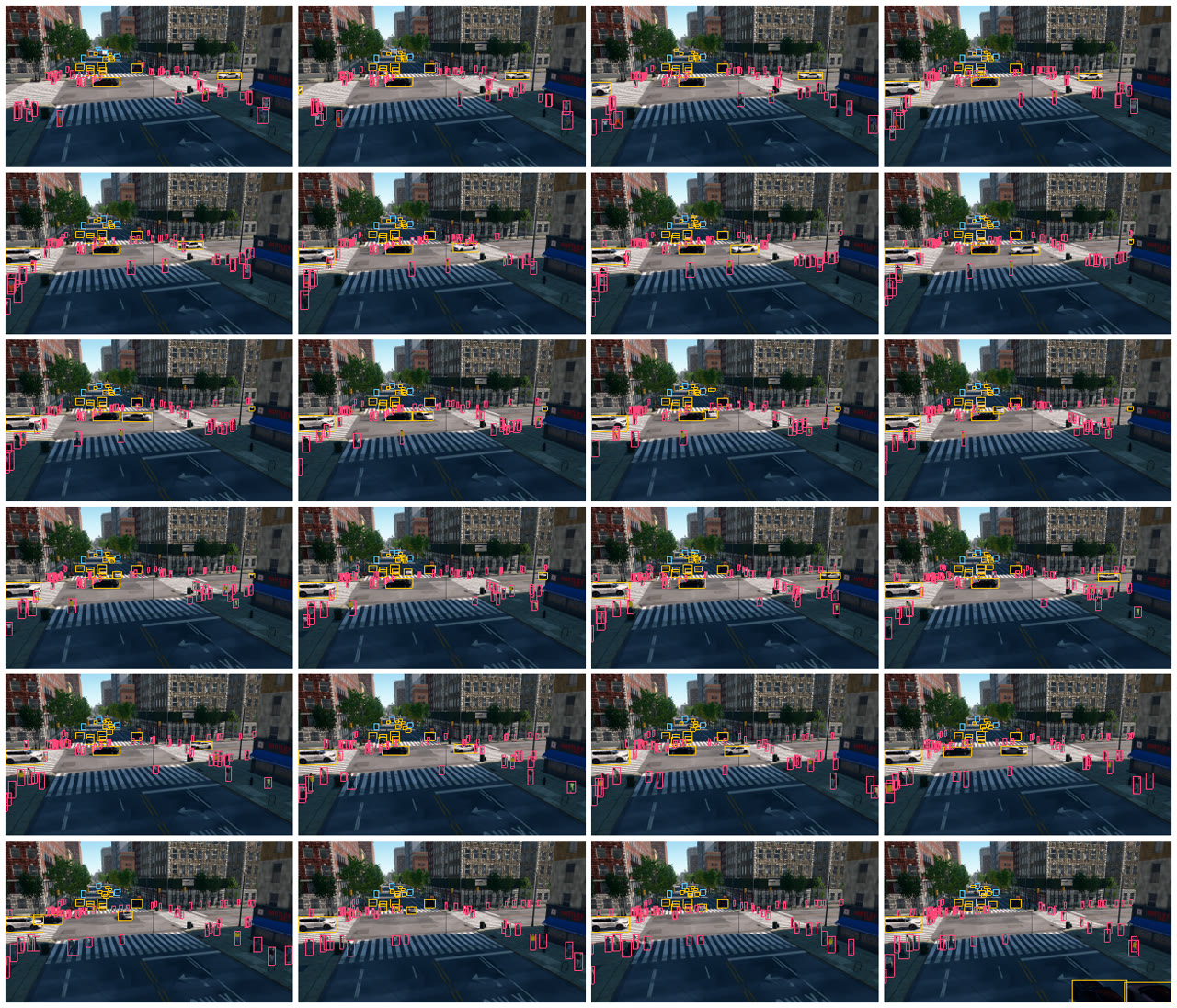
The script prints:
20 vehicles, 40 pedestrians
frame 1282: 69 road users, 41 of them spawned here
frame 1302: 74 road users, 41 of them spawned here
frame 1322: 75 road users, 41 of them spawned here
frame 1342: 77 road users, 40 of them spawned here
frame 1362: 75 road users, 40 of them spawned here
frame 1382: 72 road users, 35 of them spawned here
frame 1402: 76 road users, 37 of them spawned here
frame 1422: 77 road users, 36 of them spawned here
frame 1442: 71 road users, 36 of them spawned here
frame 1462: 76 road users, 35 of them spawned here
frame 1482: 70 road users, 33 of them spawned here
frame 1502: 75 road users, 33 of them spawned here
frame 1522: 78 road users, 38 of them spawned here
frame 1542: 80 road users, 38 of them spawned here
frame 1562: 85 road users, 39 of them spawned here
frame 1582: 79 road users, 36 of them spawned here
frame 1602: 83 road users, 42 of them spawned here
frame 1622: 75 road users, 37 of them spawned here
frame 1642: 76 road users, 39 of them spawned here
frame 1662: 74 road users, 36 of them spawned here
frame 1682: 78 road users, 34 of them spawned here
frame 1702: 70 road users, 30 of them spawned here
frame 1722: 79 road users, 34 of them spawned here
frame 1742: 82 road users, 37 of them spawned here
24 frames, 1826 boxes {'car': 378, 'bus': 0, 'truck': 74, 'bicycle': 0, 'pedestrian': 1374} -> _out/record_dataset
The complete script
"""Recording a dataset: autopilot vehicles and walking pedestrians around W 120th St and Amsterdam Ave, filmed by a pole
camera rig that records synchronized RGB, semantic segmentation, instance segmentation with labels, and depth. Writes
a COCO detection file for the road users and a contact sheet of the recorded frames. Needs numpy.

    python record_dataset.py [--host 127.0.0.1] [--port 2000] [--frames 24] [--every 20] [--vehicles 20]
                             [--walkers 40] [--out _out/record_dataset]

Output: rgb/, semantic/ (class palette), instance/ (instance codes, and the frame's labels as JSON), depth/ (16-bit
millimetres), annotations_coco.json, contact_sheet.png.
"""
import argparse
import math
import os
import queue
import random
import sys

import numpy as np

sys.path.insert(0, os.path.join(os.path.dirname(os.path.abspath(__file__)), "..", ".."))   # run from a source checkout
import valdrada  # noqa: E402
from valdrada import Location, Rotation, Transform  # noqa: E402
from valdrada.png import write_png  # noqa: E402

AMSTERDAM_120 = (40.80955, -73.95905)      # W 120th St & Amsterdam Ave, Morningside Heights
DT = 0.05
ROAD_USERS = ("car", "bus", "truck", "bicycle", "pedestrian")
COLOUR = {"car": (255, 196, 0), "bus": (80, 200, 255), "truck": (80, 200, 255), "bicycle": (150, 255, 90),
          "pedestrian": (255, 70, 120)}


def spawn_traffic(world, m, lib, junction, n_vehicles, n_walkers, rng):
    """Autopilot vehicles on lanes around the junction, and pedestrians sent between its corners."""
    actors = []
    vehicle_bps = [b for b in lib.filter("vehicle.*") if b.id not in ("vehicle.firetruck", "vehicle.ambulance")]
    spawn_points = m.get_spawn_points(center=junction.location, radius=120, spacing=16)
    rng.shuffle(spawn_points)
    for sp in spawn_points[:n_vehicles]:
        v = world.try_spawn_actor(rng.choice(vehicle_bps), sp)
        if v is not None:
            v.set_autopilot(True)
            actors.append(v)
    corners = [junction.location + Location(15 * math.cos(math.radians(arm.heading + side)), 15 * math.sin(math.radians(arm.heading + side)), 0)
               for arm in junction.arms for side in (-45, 45)]
    walkers = []
    walker_bps = list(lib.filter("walker.pedestrian.*"))
    for _ in range(n_walkers):
        start = rng.choice(corners) + Location(rng.uniform(-3, 3), rng.uniform(-3, 3), 0)
        w = world.try_spawn_actor(rng.choice(walker_bps), Transform(start))
        if w is None:
            continue
        ai = world.spawn_actor(lib.find("controller.ai.walker"), Transform(), attach_to=w)
        ai.start()
        ai.set_max_speed(rng.uniform(1.1, 1.6))
        try:
            ai.go_to_location(rng.choice(corners))
        except valdrada.ValdradaError:          # no sidewalk route between those corners
            pass
        walkers.append(ai)
        actors += [ai, w]
    return actors, walkers, corners


def outline(img, box, colour):
    x0, y0, w, h = (int(round(v)) for v in box)
    x1, y1 = min(img.shape[1] - 1, x0 + w), min(img.shape[0] - 1, y0 + h)
    x0, y0 = max(0, x0), max(0, y0)
    img[y0, x0:x1] = img[y1, x0:x1] = colour
    img[y0:y1, x0] = img[y0:y1, x1] = colour


def main():
    ap = argparse.ArgumentParser(description=__doc__, formatter_class=argparse.RawDescriptionHelpFormatter)
    ap.add_argument("--host", default="127.0.0.1")
    ap.add_argument("--port", type=int, default=2000)
    ap.add_argument("--frames", type=int, default=24, help="frames to record")
    ap.add_argument("--every", type=int, default=20, help="simulation steps between recorded frames")
    ap.add_argument("--vehicles", type=int, default=20)
    ap.add_argument("--walkers", type=int, default=40)
    ap.add_argument("--warmup", type=float, default=6.0, help="seconds of simulation before recording")
    ap.add_argument("--seed", type=int, default=3)
    ap.add_argument("--out", default="_out/record_dataset")
    a = ap.parse_args()
    rng = random.Random(a.seed)
    for sub in ("rgb", "semantic", "instance", "depth"):
        os.makedirs(os.path.join(a.out, sub), exist_ok=True)

    client = valdrada.Client(a.host, a.port)
    client.set_timeout(120.0)
    world = client.get_world()
    original = world.get_settings()
    world.apply_settings(valdrada.WorldSettings(synchronous_mode=True, fixed_delta_seconds=DT))
    m = world.get_map()
    here = m.geolocation_to_location(*AMSTERDAM_120)
    world.get_spectator().set_transform(Transform(here + Location(0, 0, 30)))
    world.wait_until_loaded()
    junction = m.get_junctions(center=here, radius=60)[0]
    lib = world.get_blueprint_library()
    actors, walkers, corners = spawn_traffic(world, m, lib, junction, a.vehicles, a.walkers, rng)
    print(f"{sum(isinstance(x, valdrada.Vehicle) for x in actors)} vehicles, {len(walkers)} pedestrians")
    sensors = []
    try:
        for _ in range(int(a.warmup / DT)):          # let the traffic spread out before recording
            world.tick()

        # the rig: four cameras at one pose; sensor_tick makes them capture only every `every` steps
        pose = Transform(junction.location + Location(-24, -24, 8), Rotation(pitch=-12, yaw=45))
        queues = {}
        for kind in ("rgb", "semantic_segmentation", "instance_segmentation", "depth"):
            bp = lib.find("sensor.camera." + kind)
            bp.set_attribute("fov", 70)
            bp.set_attribute("sensor_tick", a.every * DT)
            if kind == "instance_segmentation":
                bp.set_attribute("amodal", 8)
            cam = world.spawn_actor(bp, pose)
            queues[kind] = queue.Queue()
            cam.listen(queues[kind].put)
            sensors.append(cam)

        classes = [c for c in world.get_semantic_classes() if c["name"] in ROAD_USERS]
        coco = valdrada.util.CocoWriter(classes)
        thumbs, step = [], 0
        while len(coco.images) < a.frames and step < (a.frames + 1) * a.every:
            frame = world.tick()
            step += 1
            if step % 20 == 0:                         # walkers that arrived pick a new corner
                for ai in walkers:
                    if ai.get_state() == "arrived":
                        try:
                            ai.go_to_location(rng.choice(corners))
                        except valdrada.ValdradaError:
                            pass
            if queues["rgb"].empty():                  # the rig is not due on this step
                continue
            rgb, sem, inst, depth = (queues[k].get() for k in ("rgb", "semantic_segmentation", "instance_segmentation", "depth"))
            assert rgb.frame == sem.frame == inst.frame == depth.frame == frame
            name = f"{frame:06d}"
            rgb.save_to_disk(os.path.join(a.out, "rgb", name + ".png"))
            sem.save_to_disk(os.path.join(a.out, "semantic", name + ".png"))
            inst.save_to_disk(os.path.join(a.out, "instance", name + ".png"))     # + instance/<frame>.json
            depth.save_to_disk(os.path.join(a.out, "depth", name + ".png"))
            users = inst.filter(classes=ROAD_USERS, min_area=100)
            coco.add(f"rgb/{name}.png", users, rgb.width, rgb.height, frame=frame)

            # a quarter-size thumbnail with the boxes, for the contact sheet
            H, W = rgb.height, rgb.width
            thumb = rgb.to_numpy()[..., :3].reshape(H // 4, 4, W // 4, 4, 3).mean(axis=(1, 3)).astype(np.uint8)
            for label in users:
                outline(thumb, [v / 4 for v in label.bbox], COLOUR[label.class_name])
            thumbs.append(thumb)
            print(f"frame {frame}: {len(users)} road users, {sum(1 for l in users if l.actor_id)} of them spawned here")

        coco.save(os.path.join(a.out, "annotations_coco.json"))
        cols, pad = 4, 6
        th, tw = thumbs[0].shape[:2]
        rows = math.ceil(len(thumbs) / cols)
        sheet = np.full((rows * (th + pad) + pad, cols * (tw + pad) + pad, 3), 255, np.uint8)
        for k, t in enumerate(thumbs):
            r, c = divmod(k, cols)
            sheet[pad + r * (th + pad):pad + r * (th + pad) + th, pad + c * (tw + pad):pad + c * (tw + pad) + tw] = t
        write_png(os.path.join(a.out, "contact_sheet.png"), sheet.shape[1], sheet.shape[0], sheet.tobytes(), 3)
        per_class = {c["name"]: sum(1 for x in coco.annotations if x["category_id"] == c["id"]) for c in classes}
        print(f"{len(coco.images)} frames, {len(coco.annotations)} boxes {per_class} -> {a.out}")
    finally:
        for s in sensors:
            s.destroy()
        for x in reversed(actors):
            x.destroy()
        world.apply_settings(original)


if __name__ == "__main__":
    main()